By Charles West December 26, 2025
Scheduling has always involved more than just using a calendar in field-based industries. It dictates how well teams work together, how clients are served, and how money is eventually collected. Static timetables were the standard method for many years.
Technicians adhered to set assignments, routes were scheduled days or weeks in advance, and modifications were viewed as disruptions rather than regular occurrences. That model is being contested now. Consumer expectations have changed to include shorter service windows and quicker response times.
Unpredictable factors that field crews must deal with include traffic, weather, equipment malfunctions, and last-minute cancellations. Businesses are also under pressure to maximize utilization and keep labor expenditures under control. This has raised awareness of dynamic scheduling.
The argument now centers on resilience rather than convenience. Field operations must determine which produces greater results: predictability or adaptability. Selecting the scheduling model that actually works in the field requires an understanding of both models’ advantages and disadvantages.
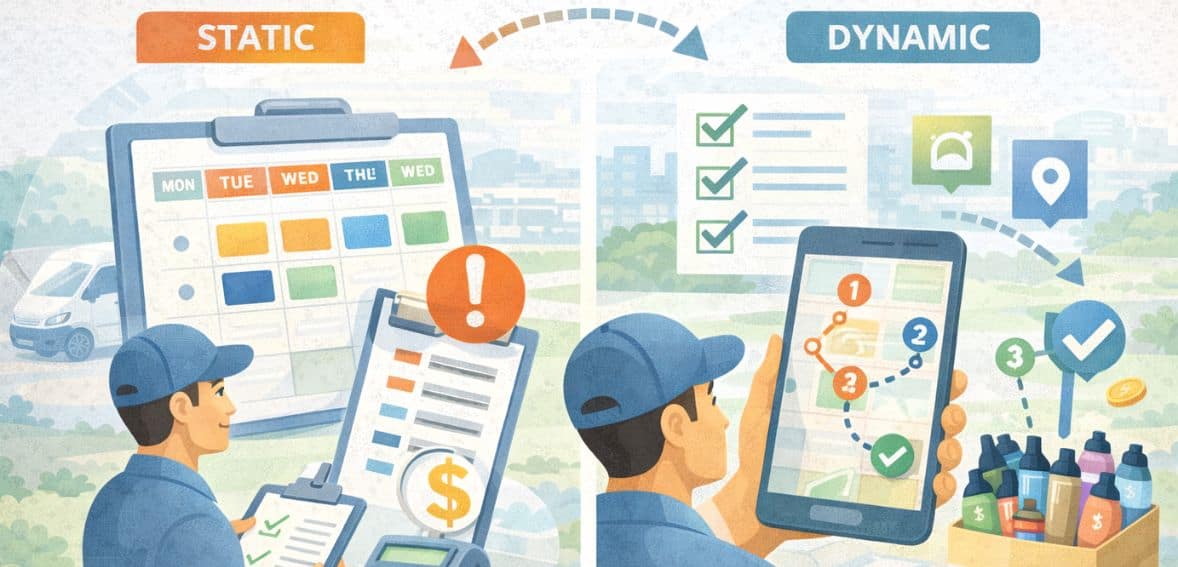
Understanding Static Scheduling in Field Operations

Fixed plans are the foundation of static scheduling. Routes are set, jobs are assigned in advance, and technicians are aware of their precise location and time. This method places a high value on predictability and structure. Customers receive confirmed appointment slots ahead of time, technicians can psychologically and physically prepare, and managers may plan workloads ahead of time.
Static schedules seem safer to many organizations. They streamline oversight and lessen daily decision-making. Teams can create procedures that increase consistency, and dispatchers do not always change plans. Static scheduling can work well in stable circumstances with known demand and few service time fluctuations.
Static timetables are tempting because of their rigidity, yet this is also their greatest flaw. Even minor setbacks can result in missed appointments, idle time, or overtime expenses when reality diverges from the plan. Static timetables are predicated on perfect circumstances, which are rarely found in the field.
What Dynamic Scheduling Really Means
Fixed plans are replaced by flexible, constantly updated timetables through dynamic scheduling. Jobs are modified in real time based on availability, location, skill set, and shifting circumstances rather than locking assignments days in advance. Although software frequently plays a major part, the idea transcends technology.
The field is handled as a living system in dynamic scheduling. Urgent requests, cancellations, early completions, and traffic delays are all expected variations. Throughout the day, the timetable changes to reflect reality rather than resist it. This strategy puts responsiveness first.
Arrival windows may be more constrained for customers. To reduce downtime, technicians are rerouted. Instead of seeing performance after the fact, managers are able to see it as it happens. While dynamic scheduling introduces complexity, it also unlocks efficiency by aligning plans with what is actually happening rather than what was predicted.
Predictability vs. Adaptability
The fundamental distinction between dynamic and static scheduling is philosophical. Predictability is given priority in static scheduling. Deviations are kept to a minimum, and everyone is aware of the strategy. Adaptability is given priority in dynamic scheduling. Although the plan is in place, it is anticipated to changed.
Customers who prefer firm commitments and technicians who appreciate routine both benefit from predictability. In settings where change seems chaotic, it might lessen stress. But when predictability regularly fails to capture reality, it becomes worthless. Organizations that deal with fluctuating demand, broad service areas, or frequent disruptions benefit from adaptability.
It enables companies to withstand shocks without completely disrupting their operations. The trade-off is that systems that can accommodate frequent changes without causing confusion, trust, and communication are necessary for adaptation. There is no intrinsic superiority between any viewpoint. The effectiveness of each depends on how closely the scheduling model matches the operational environment.
Impact on Technician Productivity
The way technicians see their work is directly impacted by scheduling. Clarity is provided by static schedules. Technicians know exactly what awaits them as they begin the day. This can help with preparedness and lessen worry.
However, technicians may feel constrained by an impractical plan when tasks take longer than anticipated or unforeseen problems occur. When people race to catch up or passively await the next allotted time, productivity falls. By cutting down on idle time, dynamic scheduling can increase productivity.
The system can allocate the next nearest assignment if a job ends early. Instead of being left waiting, technicians are redirected in the event of a cancellation. This eventually lowers unnecessary travel and raises billable hours. The drawback is that if changes are not effectively conveyed, they may seem disruptive.
Customer Experience and Service Expectations

Scheduling is seen as a promise by the client. Longer booking windows but stronger commitments are frequently provided by static schedules. Even if the window is wide, customers value knowing the precise time a specialist will come. Faster response times and more accurate arrival estimations are made possible by dynamic scheduling.
Same-day or even near-real-time service is advantageous to customers, particularly for pressing problems. Dynamic systems, however, need to exercise caution while managing expectations. Customers who prefer assurance over speed may become irritated by frequent changes that lack clarity.
Alignment leads to the finest customer experiences. While commercial clients frequently value timeliness, residential clients can prefer predictability. When deciding how much scheduling flexibility to add, it’s important to understand the consumer profile.
Cost Control and Resource Utilization
One of the biggest expenses in field operations is labor. Labor planning is simple with static schedules, but they are frequently ineffective. When schedules are overworked, overtime develops, and when there are gaps, underutilization takes place. These inefficiencies remain undetected until the end of the day. By shifting work as circumstances change, dynamic scheduling increases utilization.
By balancing workloads, it lowers overtime and boosts income by adding positions to cover gaps. This eventually results in improved margins and more precise capacity planning. However, investments in technology, training, and change management are necessary for dynamic systems. Cost savings need persistent use and rigorous implementation; they are not automatic.
The Role of Technology in Dynamic Scheduling
Manually implementing dynamic scheduling at scale is challenging. To aid in decision-making, contemporary field service platforms make use of real-time data, GPS tracking, skill matching, and predictive analytics. Throughout the day, these systems estimate job durations, compute the best routes, and suggest modifications.
Technology enhances human judgment rather than replacing it. Proactive orchestration replaces reactive problem-solving for dispatchers. Instead of focusing on single instances, managers learn about performance trends. Dynamic scheduling might lead to confusion rather than clarity in the absence of trustworthy data and system integration.
For field teams to use technology, it must be reliable, accurate, and quick. Modern field service software often integrates real-time scheduling, GPS tracking, and automated workflows, making it easier to implement dynamic scheduling without overwhelming dispatch teams.
Change Management and Team Adoption

Opposition to change is one of the main obstacles to dynamic scheduling. Technicians used to fixed schedules could see frequent changes as instability or micromanagement. Supervisors could worry about losing control over carefully planned routes. Clear communication is necessary for adoption to be successful. The objectives of dynamic scheduling—fairness, efficiency, and better results—must be understood by teams.
The benefits of flexibility for technicians, not just the company, should be emphasized throughout training. Building trust takes time. Teams become more trusting when they observe that dynamic scheduling shortens workdays, increases earnings, or reduces stress. Even the best scheduling system will not work without careful change management.
Hybrid Models: Blending Stability and Flexibility
Static and dynamic scheduling are the best options, as many field organizations find. While buffers are left for last-minute changes, core assignments may be prepared ahead of time. While lower-priority work is still variable, high-priority jobs are set in stone. This hybrid strategy allows for flexibility while maintaining predictability.
Managers are still able to adapt to developments in the actual world, and technicians maintain a feeling of order. As confidence and capability increase over time, organizations can modify the balance. The field is neither completely predictable nor completely chaotic, as hybrid models recognize. For teams moving away from strict scheduling without embracing constant change overnight, they provide a practical route ahead.
When Static Scheduling Still Makes Sense
Static scheduling is nevertheless useful despite its drawbacks. It functions well in settings with consistent demand, standardized tasks, and little unpredictability. Fixed schedules are typically advantageous for recurrent service contracts, planned maintenance, and controlled inspections.
In certain situations, dynamic scheduling may be more expensive and complicated than advantageous. Customer planning, documentation, and compliance are all supported by predictability. Making deliberate decisions is crucial. The usage of static scheduling should be based on operational reality rather than familiarity.
When Dynamic Scheduling Delivers Clear Advantages
High-variability situations are ideal for dynamic scheduling. Continuous optimization helps globally distributed teams, emergency services, and on-demand repairs. Businesses that deal with erratic demand, frequent cancellations, or strict service-level agreements frequently notice results right away.
The change is justified by faster response times, increased usage, and enhanced customer satisfaction. Dynamic scheduling focuses on intelligent response rather than continuous mobility. When done correctly, it turns chaos into coordination.
The Impact of Scheduling on Employee Retention

Unbeknownst to many field businesses, scheduling has a significant impact on employee retention. When plans constantly fall short of reality, and technicians are forced to rush or put in extra time, static schedules can lead to tiredness. This gradually lowers morale. When used carefully, dynamic scheduling can lessen stress by dispersing duties and cutting down on unnecessary travel.
However, if boundaries are not upheld, persistent unpredictability can also wear down teams. Balance is the key. Technicians are more likely to stick around if they believe their workloads are reasonable, routes make sense, and their time is respected. Scheduling shows how much a firm values its employees and is more than just an operational tool.
Dispatch Decision-Making in Real Time
Dispatchers’ roles are radically altered by dynamic scheduling. Dispatchers become decision facilitators backed by real-time data rather than manually handling exceptions. They keep an eye on work progress, foresee delays, and step in before minor problems get out of hand.
Although this change increases service dependability, it also calls for improved situational awareness and analytical abilities. Static scheduling increases reactive firefighting when plans don’t work out, but it requires less judgment in real time. Dispatcher confidence is crucial in changing circumstances.
Decision-making can be avoided with the use of system recommendations, escalation routes, and clear regulations. Real-time scheduling turns into a competitive advantage rather than a disadvantage when dispatch teams are empowered rather than overburdened.
Scheduling Transparency and Internal Trust

How schedules change matters as much as why they change. When technicians do not understand the logic behind adjustments, trust erodes. Static schedules rarely change, but when they do, frustration is high. Dynamic scheduling requires transparency to succeed. Teams need visibility into why rerouting happens, how priorities are set, and how fairness is maintained.
Clear communication reduces the perception of favoritism or randomness. Transparency transforms scheduling from something done to technicians into something done with them. Internal trust grows when changes feel purposeful rather than arbitrary, supporting long-term adoption and smoother daily operations.
Measuring Success in the Field
The success of any scheduling model should be measured against outcomes, not ideology. Key indicators include first-time fix rates, technician utilization, customer satisfaction, and overtime costs. Static schedules may score well on predictability but poorly on adaptability. Dynamic schedules may improve efficiency but require monitoring to prevent burnout.
Regular review ensures that the chosen model continues to serve both the business and the field teams effectively. Tracking first-time fix rates helps field teams assess the effectiveness of their scheduling model and pinpoint opportunities to improve efficiency and customer satisfaction.
Conclusion: Choosing What Works, Not What’s Trendy
It’s not about following trends when deciding between dynamic and static scheduling. Aligning operations with reality is the key. Static schedules provide simplicity, clarity, and consistency. Flexibility, reactivity, and efficiency are provided by dynamic scheduling. Because field conditions are complicated, there isn’t a single strategy that works in every situation.
Successful organizations appreciate their teams, understand their operating routines, and create scheduling methods that promote both productivity and well-being. In the end, the most effective scheduling model is the one that consistently provides value in the uncertain realm of field operations and can adjust to change without losing structure.
FAQs
Are small field teams a good fit for dynamic scheduling?
Yes. Dynamic scheduling works well for small teams when job variability is high and the tools used are simple, reliable, and widely adopted by the team.
Does dynamic scheduling increase technician stress?
Not necessarily. Well-managed systems often reduce stress, but stress can rise if schedule changes lack clear boundaries or transparency.
Are static schedules still relevant in modern field operations?
Yes. Static schedules remain effective in environments with recurring work, compliance requirements, or minimal day-to-day variability.
What is the biggest risk of dynamic scheduling?
Poor data quality and weak change management can undermine efficiency and erode trust among technicians.
Should businesses switch fully to dynamic scheduling right away?
Most successful businesses start with a hybrid approach and transition gradually as teams adapt.